
Ferry County Criminal Docket Searches
Pick the court before anything else. Felony prosecutions live in Ferry County Superior Court. Its records rest with the Ferry County Clerk. District Court handles misdemeanors, gross misdemeanors, criminal traffic matters, and probable-cause hearings on felonies. The statewide JIS Search Case Records form covers both courts. But it works only after you choose the right level and case type.
Superior Court cases get a richer view through Odyssey, though JIS can find them too. For District Court, skip Odyssey and stay with JIS. A full case number is the strongest search key. Without one, use the defendant name from the court papers and narrow by filing year. Washington publishes no Ferry-specific number pattern, so never guess at or alter a number.
- Identify Superior Court or District Court from the papers and offense level.
- Choose Ferry County Superior Court with Criminal, or Ferry County District Court with the apt criminal type.
- Search by full case number when known, or use the recorded first and last name.
- Open the match and compare court, file date, party role, status, and events.
- Ask the proper clerk for the current file, a document, or a certified copy.
Ferry Superior Odyssey Search
The Odyssey Portal Smart Search takes a record number or a name. Filters cover location, search type, case type, status, file dates, and judicial officer. A wildcard is allowed under the state guide. That guide also warns that only the first 200 results display. A common surname needs narrowing. So add Ferry location, criminal case type, and a tight date span. Anonymous users see case information. Document access, while, hinges on county settings, record restrictions, and user role.
The manifest shows the Odyssey entry used for Ferry County Superior Court. View the official Odyssey source before comparing the fields.
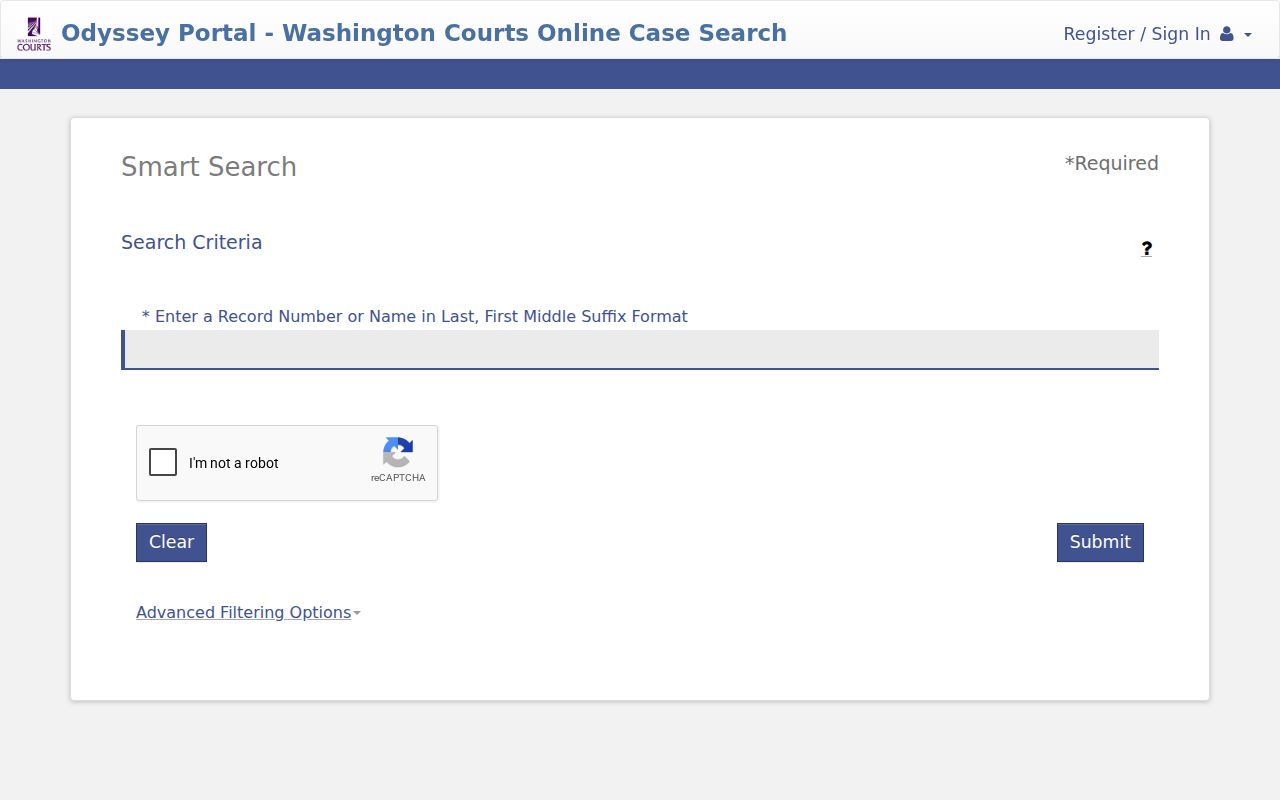
That screen is only a search interface, not a criminal docket and not a ruling. Once a result comes up, open the case header and Register of Actions. Then verify the key facts with the Ferry County Clerk.
Criminal Dockets: What They Show
A Ferry County criminal docket names the case before it narrates it. The header comes first: case number, court, location, file date, judicial officer, type, and status. From there, check the State or government side against the defendant role. Note any attorneys the public system displays. Charges may be listed, but a charge is only an allegation, never the outcome. The dated events then give the case its procedural history.
| Case number | The court-assigned identifier. Enter the full value in Case Number when known. |
|---|---|
| Charge | The public charge or class, when displayed. It does not establish disposition. |
| Hearings | Date, time, type, location, and judicial officer, subject to later resets. |
| Events | Arraignment, plea, motion, order, pretrial, trial, sentencing, review, appeal, or closure. |
| Disposition | The event block that records a resolution. Read it with the full sequence. |
JIS usually stays at index level. Odyssey can go deeper, sometimes with document links where the county enables them. Neither system promises every filed image to an anonymous user. A blank document area does not mean no filing exists.
Ferry Criminal Docket Numbers
Washington Courts' 2025 Superior Court annual report counts 41 criminal filings for Ferry County in its statewide criminal category. It also counts 43 resolved criminal cases. Those totals describe report activity alone. They are not the count of open cases today. And they say nothing about the District Court misdemeanor load. Never add them to limited-jurisdiction figures without matching the report definitions first.
The numbers give a sense of scale for a small county docket. They also show why an annual total can clash with a portal search run today. Filters, filing dates, court level, restrictions, and later events all change what a search returns.
Criminal Case Stages on the Docket
Events run in date order. Arraignment is the appearance where the charge and procedural rights get addressed. A plea is the defendant's formal answer. Motions ask the court to rule; orders record what the court directed. Pretrial and trial-readiness entries track preparation, while trial, sentencing, disposition, review, or appeal marks a later stage. Not every case hits every stage.
Docket flow: Filing › Arraignment › Pretrial › Plea or Trial › Disposition › Sentencing
Ferry County's arraignment information tells defendants they have rights to counsel. They may get appointed counsel if they qualify. Staff can hand over forms and explain process, but they cannot give legal advice. Read the dated entries in order. A plea, a judgment, and a disposition are distinct. And an appeal may open a new record.
Ferry Criminal Docket Mornings
The Ferry County District Court page says court generally runs Wednesdays, with criminal dockets starting at 9:00 a.m. One exception matters. Trial weeks usually fall in the first Superior Court week and the third District Court week of each month, so the weekly rhythm alone won't tell you when one case appears.
Confirm the setting: Use Find My Court Date for District Court or Odyssey Search Hearings for Superior Court, then call the court the morning of the proceeding because settings can change.
CalendarWiz serves Tri-County Superior Court as a public aid, but the court itself warns it is no substitute for Odyssey or the official docket. Webex lets you watch or attend a public proceeding in session. It is not a docket archive.
Ferry County Criminal Docket Courts
Two courts split the Ferry County criminal docket. Superior Court, which shares a Tri-County district with Stevens and Pend Oreille Counties, takes the felony filings. Its records live with County Clerk Melanie Breezee, whose office sits in Suite 4 at 350 E Delaware Avenue, Republic, WA 99166. Call 509-775-5225 ext. 2505. Hours run 8:00 a.m. to 4:00 p.m.
District Court handles the rest: misdemeanors, gross misdemeanors, criminal traffic, and probable-cause felony proceedings. You will find it in Suite 6 at the same courthouse. The phone is 509-775-5225 ext. 2504, with a fax line at 509-775-5221, and the counter opens 8:00 a.m. to 4:00 p.m. Monday through Friday, minus legal holidays. One caution: the Prosecuting Attorney holds prosecution-office records but does not keep the criminal docket itself. That job belongs to the clerk.
Missing Ferry Criminal Cases
When a Ferry County name fails to come up, the culprit is usually the search setup. Felonies live under Superior Court Criminal. Misdemeanors and criminal traffic cases belong with District and Municipal Courts. Pair those with the right JIS category. JIS updates its public data within about 24 hours. But it also warns that status, docket, judgment, or document links may be incomplete or inaccurate. So a missing result is not proof of anything.
Still nothing? Call the County Clerk for Superior Court matters, or District Court for limited-jurisdiction cases. Records that are available can be inspected at the counter. Before you email or fax personal data, ask the staff first. Mailed Superior Court requests go to the County Clerk at the Republic courthouse. You should confirm payment, delivery, and postage terms in advance. GovQA serves county administrative records only. It is no substitute for the clerk's judicial-record process.
Ferry County Criminal Dispositions
A charge line and a disposition line answer different questions. Confusing them misleads readers of a Ferry County docket. The charge says what the case alleges. The disposition records how the case, or part of it, was resolved. Pleas, dismissals, judgments, sentencing entries, and appellate events can land on different dates. So any single line can distort the real procedural posture.
Read the docket from the filing date forward to the latest event. Notice whether one count changed while another stayed put. Ask whether an order was interim or final, and whether an appeal followed the trial-court result. If an event label is unclear or the image is unavailable, ask the records custodian for the filed order. Do not guess at its terms.
Access Rules for Criminal Dockets
Washington's General Rule 31 puts dockets, registers, calendars, orders, judgments, indexes, and filed papers within the definition of court records. All of it stays subject to laws, rules, and court orders. Walking into the courthouse to view a file is free. Copies or certification may carry statutory fees. Treat the public index as a finding aid only. The clerk holds the complete, current record.
Limits exist, and they matter. Juvenile offender records never appear on the public statewide index. Sealed and restricted cases stay closed to anonymous Odyssey users. Protected material and personal identifiers may be redacted. Judge notes or drafts are not public court records at all. When access seems blocked, contact the clerk about lawful options instead of working around the restriction.
Key rules:
Washington GR 31 defines public access to court records and its limits.
RCW 13.50.050 governs access and confidentiality for juvenile records.
RCW 13.50.260 addresses juvenile record sealing and access.